This guide breaks down everything you need to know about artificial intelligence courses in Germany, including costs, top universities, career opportunities, and how to navigate the application process successfully.
Why Germany Is a Top Choice for AI Studies

Germany’s standing in AI is not accidental. It is the product of deliberate national investment. The federal government’s AI strategy has directed billions into research infrastructure, university-industry collaboration, and the development of applied AI centres across the country. What this means for students is an academic environment where theoretical learning sits alongside genuine industry engagement, and where the gap between a university laboratory and a corporate R&D team is often measured in minutes rather than miles.
Germany’s strengths for AI students are substantial. Public universities offer globally recognised AI programmes with minimal or no tuition fees. The country has deep industry connections with companies like SAP, Siemens, and Bosch, all of which actively recruit AI graduates. Demand for AI professionals is rising sharply across automotive, healthcare, finance, and manufacturing sectors. And graduates have the opportunity to stay and work in Germany after completing their degree through an 18-month post-study work visa.
Germany’s focus on research and practical learning makes it an ideal destination for those who want to go beyond theoretical knowledge and build careers in applied AI.
Structured career counselling helps students evaluate whether Germany’s AI landscape aligns with their long-term goals and identify the programme level and specialisation that fits their profile.
Popular Artificial Intelligence Courses in Germany
Prospective students researching AI programmes in Germany will find the academic landscape considerably more varied than in many competing destinations. Options span undergraduate degrees, taught Master’s programmes, research-focused postgraduate tracks, and English-medium professional Master’s courses designed for international students.
The majority of career-focused applicants gravitate toward a Master’s qualification, largely because the depth of specialisation it offers directly translates into the roles industry is actively recruiting for. Bachelor’s programmes in AI typically run for three to four years and cover programming, data science, and machine learning fundamentals, making them suitable for students starting early in the field. Master’s programmes, usually lasting one and a half to two years, offer specialisations in machine learning, robotics, data science, and natural language processing, and are the most popular choice among international students.
Specialised AI and data science programmes, including short-term certifications or diplomas, focus on practical skills and industry tools and are well-suited to working professionals looking to upskill. Public universities in Germany are highly reputed and often charge minimal tuition fees, making them a compelling choice across all programme levels.
University and course selection guidance helps students identify which AI programme and institution in Germany best matches their academic background, career ambitions, and financial planning.
Top Universities Offering AI Programmes
Germany is home to several universities known for their strong AI and computer science programmes. Public universities often offer tuition-free education, though admission can be competitive and requires a well-prepared application.
Some widely recognised institutions for AI studies in Germany include the Technical University of Munich, RWTH Aachen University, University of Stuttgart, Saarland University, which has a particularly strong focus on AI research, and Humboldt University of Berlin. These institutions are known for their cutting-edge research, industry collaborations, and global recognition across the AI and technology sector.
For Indian students exploring Germany as a study destination, Envision Education’s partner universities include Berlin School of Business and Innovation, EU Business School, University of Europe for Applied Sciences, and GISMA University of Applied Sciences, all of which offer English-taught programmes in technology, business, and related disciplines.
Cost of Studying AI in Germany
Cost is one of the most compelling arguments for choosing Germany over Anglophone alternatives. Public universities in Germany charge no tuition fees for most programmes, including many taught in English, regardless of whether the student is a domestic or international applicant. Where fees do apply, typically at private institutions, they remain substantially lower than comparable programmes in the United States or the United Kingdom.
At public universities, students typically pay only an administrative fee of €150 to €300 per semester. Private universities charge between €10,000 and €20,000 per year. Monthly living expenses, covering accommodation, food, transport, and insurance, range from €850 to €1,200. A blocked account of approximately €11,208 per year is required as proof of funds for living expenses when applying for a student visa.
Scholarships from DAAD, university funding, and government grants can reduce these costs significantly. For a field as resource-intensive as AI, studying in a country where your total costs remain manageable is a significant strategic advantage.
Structured financial assistance guidance helps Indian students plan their Germany study budget realistically and identify scholarship and funding opportunities before they apply.
Admission Requirements for AI Courses
To apply for artificial intelligence courses in Germany, students must meet specific academic and language requirements. On the academic side, a completed undergraduate degree in computer science, mathematics, IT, statistics, or a related quantitative field is required, along with a strong background in programming and data structures.
For language requirements, English-taught programmes require IELTS or TOEFL scores, while German-taught courses require proof of German language proficiency. Supporting documents typically include a Statement of Purpose, Letters of Recommendation, and a detailed CV or resume. Having a strong profile with relevant projects or internships can meaningfully increase your chances of admission at competitive institutions.
Structured application guidance helps students build strong, complete applications, from crafting compelling Statements of Purpose to compiling all supporting documents accurately.
Career Opportunities After Studying AI in Germany
Germany offers excellent career opportunities for AI graduates. The country is actively investing in AI across industries like automotive, healthcare, finance, and manufacturing, creating consistent demand for graduates across multiple specialisations.
High-demand job roles for AI graduates in Germany include Machine Learning Engineer, Data Scientist, AI Researcher, Robotics Engineer, Computer Vision Specialist, NLP Researcher, and Business Intelligence Analyst. The AI job market spans well beyond the technology sector, with graduates moving into roles across automotive companies, financial services firms, healthcare organisations, and manufacturing enterprises.
Earning potential for AI professionals in Germany is highly competitive. Entry-level positions typically open between €50,000 and €65,000 annually. Mid-level professionals with three or more years of applied AI experience regularly earn between €70,000 and €90,000. Senior and specialist roles at major technology firms or research institutes can exceed €100,000.
Geography plays a meaningful role in compensation. Munich, Berlin, and Frankfurt concentrate the highest density of technology companies, AI startups, and research-driven multinationals, and salaries in these cities reflect that demand. Graduates who position themselves in these hubs tend to access the upper range of the market considerably faster than those in smaller cities.
Work Opportunities and Post-Study Benefits
Germany allows international students to stay and explore job opportunities after completing their studies. The 18-month post-study work visa gives graduates meaningful time to secure employment in their field without the pressure of an employer-sponsored immigration requirement. Once employed in a skilled role, graduates can convert to a long-term work permit, which opens pathways to permanent residency in Germany.
Students can also work part-time during their studies, helping them manage living expenses and gain practical industry experience from an early stage. This combination of affordable education, strong career prospects, and a clear post-study immigration pathway makes Germany one of the most strategically attractive AI study destinations for Indian students in 2026.
Structured visa guidance helps students navigate both the German student visa process and the subsequent post-study work visa pathway with accuracy and confidence.
How to Choose the Right AI Programme
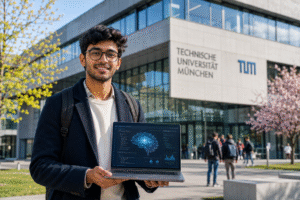
Selecting the right programme is crucial for long-term success. The course curriculum and specialisation options should align with your specific area of interest within AI, whether that is machine learning, robotics, natural language processing, or data science. Universities with strong industry collaborations offer internship placements and research projects that translate directly into employment advantages after graduation.
Evaluating internship and research opportunities within each programme gives a clear picture of the practical exposure available. Location matters too, with cities like Munich, Berlin, and Frankfurt offering the strongest job market access for AI graduates. Comparing costs and scholarship options across public and private institutions helps ensure your financial planning is realistic before you commit to an application.
Why Choosing the Right Guidance Matters
Planning to study abroad involves multiple steps, from choosing the right university to obtaining a visa and securing accommodation. Having structured expert support at each stage ensures a smoother journey and reduces the risk of costly errors.
A comprehensive approach covers career counselling and profile evaluation, university shortlisting, application preparation, visa guidance, scholarship identification, and pre-departure support. At Envision , counsellors work directly with students to match their profile with the most appropriate German partner university, prepare strong applications, and navigate every stage of the process from shortlisting to arrival.
FAQs
1. Is Germany good for studying Artificial Intelligence?
Yes. Germany is one of the strongest countries for AI studies due to its advanced academic infrastructure, government investment in AI research, strong industry connections, and growing demand for AI professionals across multiple sectors.
2. What is the cost of studying AI in Germany?
Public universities in Germany charge minimal administrative fees of €150 to €300 per semester, with no tuition fees for most programmes. Living expenses range from €850 to €1,200 per month, making Germany significantly more affordable than the US or UK.
3. Can I study MS in AI at German public universities?
Yes. Many public universities in Germany offer MS programmes in AI with little to no tuition, making them highly popular among international students seeking advanced AI education.
4. What are the job opportunities after AI studies in Germany?
Germany’s AI job market spans well beyond technology. Graduates move into roles such as machine learning engineer, data scientist, computer vision specialist, NLP researcher, AI product manager, and AI solutions architect across automotive, healthcare, financial services, logistics, and manufacturing industries.
5. What is the average salary for AI professionals in Germany?
Compensation for AI professionals in Germany ranges between €50,000 and €100,000 annually. Entry-level positions typically open between €50,000 and €65,000. Professionals with three or more years of applied AI experience regularly command figures above €80,000, and senior specialist roles at major technology firms can exceed €100,000.
6. How does Envision help students apply for AI programmes in Germany?
Envision Education provides end-to-end support including career counselling, university shortlisting, application preparation, visa guidance, and pre-departure assistance. With direct partnerships with German institutions, counsellors guide students through every stage of the process with specific, accurate knowledge of each institution’s requirements.
Final Word
Germany offers a compelling combination of quality education, affordability, and career opportunity that few countries can match for AI students. From world-class universities and minimal tuition fees to high-paying graduate roles and a clear post-study immigration pathway, Germany provides the foundations for a successful and sustainable career in Artificial Intelligence.
If you are planning to study AI abroad, now is the right time to explore your options. Speak with an Envision counsellor today and take the next step toward a future-ready career in one of the world’s most in-demand fields.